
Galaxian Gameplay
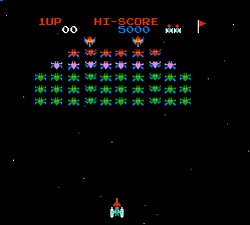
You're parked at the bottom edge of the screen, like the lip of a runway. Your cannon is just a spark in the void. Above, a tight alien squadron forms up: neat ranks, shimmering colors, a steady hum. Then—snap and hiss—a pair of "dragonflies" breaks off and knifes into a steep dive. Galaxian opens politely, but it’s a feint. Within a minute you’re running on reflex, catching shot timing, reading arcs, and feeling it in your bones: one miss and the next swell scrapes the breath right out of you. This space arcade doesn’t push you through a script; it runs on cadence: slide left-right, short exhale, and a single bullet on screen. While it’s flying, you’re unarmed. That constraint breeds a special focus—the classic "one shot, one chance" loop that makes Galaxian so magnetic.
Rhythm of the fight
The enemies don’t just hang there like a wall—they feel alive. The "insect" formation rocks lazily, baiting you in, then a wing snaps free and dives in an arc, firing as it comes. Waves roll like surf: fresh squadrons, bolder every cycle. There’s no boss in the usual sense, but there is a flagship—bright, stubborn, arriving under cover. When it dives with escort, a little duel begins: intercept the guards first, then catch the captain in a perfect window. Whiff it and he rockets back to the ranks, leaving you with an empty screen and burning palms. That’s where an invisible timer is born—unseen, but felt on your skin: the window for a clean shot is brief, and split-seconds decide everything.
One shot — many decisions
The heartbeat of Galaxian is fire discipline. No autofire, no sprays. You hold your round like a breath: rush it and the bullet sails wide while a diver threads the gap; wait too long and you lose position. That one-bullet "cooldown" trains you to play to the screen’s tempo: step left, take the arc, pull a lone shooter into empty space, then press. Eventually you hear the wave’s "music": how the top row shifts, where the blues leave holes, where the reds love to cut the corner. A wordless strategy emerges—the "Galaxian tactics" friends used to argue over at kitchen tables and on stoops.
Dives and traps
The peak is that beat when three or four come down in a wedge and you’re forced to dance more than shoot. Dodging becomes as much a weapon as aim: give up center, slip to the edge, bait the curve into your shot. Players who farm only "easy" targets in formation hit their ceiling fast. The real joy is catching attackers on a head-on, shredding the escort, and plucking the flagship at the apex. The payout is classic arcade: the score rockets, the screen showers starry points, and you want another go. That’s the score-attack groove—you’re not just surviving anymore, you’re risking for the record.
Waves and speed
Every new wave looks like the last—and not at all. Patterns are readable, but the tempo creeps up quietly: arcs sharpen, windows narrow, aim must be cleaner. Galaxian never bullies with difficulty; it persuades. First you play to "get through," then you play to "stack points." Soon you’re deliberately leaving a couple in formation to lure them into dives on your preferred curve, practicing "fishing" for singles and counting the beat on a half-breath. That’s how you reach the "I’m steering the chaos" state—the reason we boot retro shooters on Dendy and Famicom, however the sticker was printed.
Flagship and escort
Score-chasers know: the flagship with cover is a gold mine. The trick is simple and dangerous—strip the escort without losing the leader from your sights, then land a perfect round the moment he opens up and hooks into a curve. The reward is visceral—not just numbers but sound and flash. That little mini-event in every wave makes "Galaxy" (as some old cartridges had it) feel lively and hungry. When it all lines up, you feel like a pilot who pulled the impossible—a clean blade slipped in at the very top of the attack.
Control and the feel of flight
The controls are almost guitar-like: left-right riff, a quick button snap—back on beat. No wasted motion, all about clean intent. This isn’t bullet hell with a carpet of shots; it’s a midrange duel: your composure versus their speed. When the screen starts to whistle with fire, one rule saves you—always leave yourself an exit lane. Nudge the swarm into a zone where you work best, then hold the tempo. Galaxian quietly teaches arcade fundamentals: read the screen, don’t get boxed in, shoot on the moment rather than just at the sprite.
Hunting the high score
The score isn’t just digits—it’s a diary of your focus. Yesterday you fell on wave four; today you’re holding ten; tomorrow you’ll look beyond. "How to play Galaxian" shifts from beating the game to building habits: where to thin the ranks, when to risk, when to let go of greed. You start spotting invisible tells: "double dives incoming," "flagship will break early." Those little epiphanies are why you come back. Some households called it simply "Galaxian," others "that space bug shooter." The name doesn’t matter. The pulse that grabs you in the opening seconds and holds you until you hit your ceiling—that’s what counts.
And when you nail the escorted flagship at the limit, the screen seems to hold its breath with you. Your fingers still trace the path while your brain whispers, "One more run—this time I beat it." That’s Galaxian: an honest arcade where every victory is earned with hands and head. Whether it says "Галаксиан," "Galaxian," or the old multicart "Galaxy," the magic inside is the same—pure rhythm, clear rules, and an endless hunt for the perfect shot.