
Galaxian story
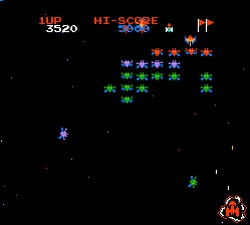
Galaxian has a rare arcade biography: born to the clatter of Japanese game centers, then coming of age at home on consoles. You can almost smell the quarters in your pocket, hear that unmistakable siren in your ears—and the little ship is already waiting on the launchpad. In Russia folks usually said “Galaxian,” sometimes leaving it in Latin, just like on the carts—and it felt like the password to a secret club of space-shooter diehards. Namco built it as an answer to the Space Invaders craze, but instead of neat marching ranks you got enemies that peeled off, corkscrewed, and dive-bombed—brazen and beautiful. That swagger is why players fell for it first in arcades, then on the NES, where it became a welcome regular, almost a family ritual.
From arcades to the living room
The story starts at Namco, and back then that name meant straight-up arcade magic. Cabinets with blinking buttons, leaderboards glowing overhead—initials crushed into three letters of glory. Galaxian stood out right away: colorful enemies, a starfield that streamed by, and attack waves that felt alive, like a flutter in your knees. It made you queue up, throw in your last coin “for one more try,” and learn to ride the rhythm and gamble at the right second. When it landed on the Famicom under the Namcot label, then on the NES, the spell didn’t break. It just changed sets: from a stool by the cabinet to the carpet in your living room, from the hum of a game hall to the soft hush of a night at home. But the start jingle, that starry sky, and those audacious dives—those stayed put.
The 8-bit port didn’t try to be “bigger, better, louder”—it was honest. That feeling of facing down a wave, one-on-one, slid neatly into a cartridge and became an everyday thing. In Japan, the box wore the strict Namcot logo; in America, the NES crowd met it; and across our side of the world, people often saw it on Dendy—those infamous “9999 in 1” multicarts where “Galaxian” blinked modestly in the menu. Tap Start and you’re tossed back into the black with pinprick stars, where it all comes down to a cool head and hot hands.
Why it clicked with everyone
Galaxian didn’t bother with long intros or tangled rules: it’s pure arcade, learn-as-you-go. That’s its strength. It’s as lean as a clean boxing jab: a ship, a ribbon of stars, and waves that break formation to strike solo. Every new run feels like a blitz chess match against sky-bugs at twice the speed. The home version kept that personality intact, which is why it stuck around: nightly arguments over who owned the high score, argued fair, no cheats, no rewind buttons. Little leaderboards popped up in kids’ rooms and kitchens—scrawled in a notebook, on a scrap of paper, on the back of the cartridge box. The NES pulled off what no cabinet could: it let you live with Galaxian, come back whenever you wanted, and switch from guest pilot to regular.
There’s another piece that matters for our local timeline. In post-Soviet apartments, the “space shooter” became a bridge to the wider arcade culture. We mostly saw Dendy, not Japan’s Famicom, yet Galaxian was how many first felt what “arcade classic” really meant. Names like Namco, Galaga, and Space Invaders became familiar not from articles, but from your own evenings at the TV. Sometimes both games—Galaga and Galaxian—shared the same multicarts, which led to mix-ups. But the moment you saw enemies stack overhead, pause, then swoop in a heartbeat—there was no doubt. This was Galaxian, the one where victory rests on split-second timing and nerves of steel.
Echoes of the arcade
Memory clings to the details: that quivering start siren, the first shot, the narrow lane you thread between two diving enemies. Those fragments settled into the muscle memory of a generation. And it didn’t matter if you faced a gleaming cabinet or a humble gray NES cart—the feeling was the same: you’re a visitor in an endless galaxy with one job—last a little longer. Galaxian doesn’t tell a story with words; it tells one in motion. It’s a journey from a Namco cabinet to a home couch, where anyone can catch the wave, read the attack pattern, and squeeze a few more points onto the board.
That’s how the game stuck with us—not as a museum piece, but as a living ritual. First a short inhale, then Start, and then a rhythm you could pick out anywhere. Galaxian taught us the simple joy of the arcade: when the whole world shrinks to a ship and a starfield, and everything else can wait. And that’s the secret of its long life on the NES: no extra gloss, no big speeches—just a precise, honest coin-op spirit that moved in, found a home, and never left.